
Copper peptides, particularly the well-studied GHK-Cu complex, are powerful molecules that act as the body's internal repair signals. These naturally occurring peptides are widely recognized in skincare, but emerging research highlights their broader role in hair strengthening, wound healing, tissue regeneration, and cellular longevity. Because natural levels of copper peptides decline significantly with age, the body's response to inflammation, collagen synthesis, and cellular communication becomes limited—driving increased interest in therapeutic peptide options at our wellness compounding pharmacy.
Copper Peptides and its Abundant Molecular Uses
How Copper Peptides Work
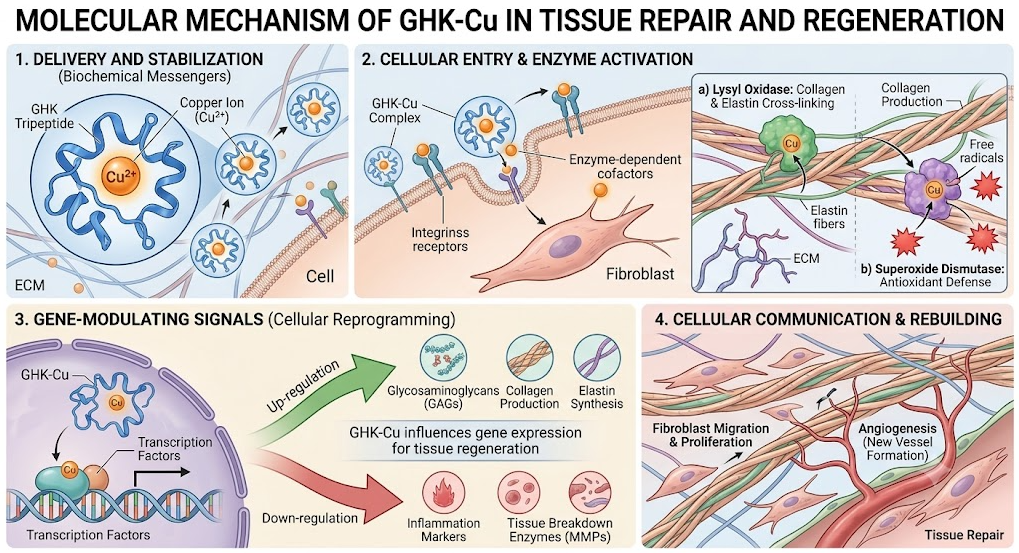
On a molecular level, copper peptides function as biochemical messengers that deliver copper ions precisely where they are needed, triggering a cascade of repair processes. GHK (glycyl-L-histidyl-L-lysine) is an endogenous tripeptide isolated from human plasma that tightly binds copper ions to form the stable GHK-Cu complex. This stabilization allows cells to easily recognize and utilize copper for essential biological functions, including gene signaling, enzymatic activation, and tissue regeneration.
Going a little deeper, GHK-Cu plays a key role in gene-modulating signals. Studies show that GHK-Cu can up-regulate and down-regulate a multitude of genes involved in inflammation control, tissue repair, and cellular growth. In research, copper up-regulated genes associated with glycosaminoglycan, collagen, and elastin production while simultaneously suppressing genes associated with inflammation and tissue breakdown. This level of influence contributes to the reprogramming of cells for tissue regeneration and longevity. (3)
Lastly, GHK-Cu's role in cellular communication involves signaling cells to migrate, proliferate, and rebuild. This can be seen in rebuilding fibroblasts, promoting angiogenesis, and assisting with overall tissue repair.
Pro-Tip: Quality & Custom Formulation Matters for Peptide Therapy
Human plasma levels of GHK-Cu decline significantly with age—dropping by up to 60% by age 60. While restoring this vital peptide supports cellular health, over-the-counter cosmetic products often contain insufficient concentrations or lack proper skin-penetrating delivery vehicles. For therapeutic applications in skin regeneration, scalp vitality, and anti-aging, partnering with a specialized wellness compounding pharmacy ensures access to pharmaceutical-grade GHK-Cu formulations. Custom compounding allows for precise peptide concentrations, specialized transdermal bases, and clinical oversight tailored to your specific health goals.
Benefits for patients
Anti-Aging and Skin Regeneration
The addition of GHK-Cu to skin care works at the molecular level by signaling the fibroblast to produce collagen, elastin, and glycosaminoglycans to naturally repair its structural matrix. This leads to physically firmer and smoother skin over time. The addition of GHK-Cu also reduces inflammation and oxidative stress, resulting in a much stronger skin barrier. From a dermatologist’s point of view, the addition of GHK-Cu plays a supportive role by repairing the biological components of the skin; retinoids will resurface, vitamin C will brighten, and acids will exfoliate. (2)
Wound Healing and Tissue Repair
The addition of GHK-Cu to wound care works the same as in skin care, by signaling the fibroblast to produce new collagen, elastin, and glycosaminoglycans, and reducing inflammation around the injury to naturally rebuild a new extracellular structural matrix. All of these components are essential steps in closing and strengthening a wound. Currently, in studies, the addition of dimeric GHK-Cu to diabetic wound healing has been highly effective at counteracting factors that slow the healing process in diabetic patients. The complex is promoting angiogenesis and improving cellular communication, while helping to create an environment with lower ROS levels for healthier tissue repair. (1)
Hair Strengthening and Growth
Adding GHK-Cu to your hair care routine creates a healthy environment around the follicle and signals for the scalp to shift toward hair growth. This is done by reducing inflammation around the follicle, increasing blood flow, and stimulating the proteins that are needed for healthy hair. It also helps with the protection of the follicles from ROS, a major contributing factor to thinning hair. Due to these benefits, studies show that GHK-Cu is relevant in treating alopecia because of chronic inflammation, small follicles, impaired signaling, and disruption of the normal hair cycle. (4)
General Wellness and Supplement Use
Due to GHK-Cu's ability to support the body’s natural repair systems at a cellular level, it has gained attention in the wellness arena. As a signaling peptide, it helps regulate genes involved in tissue repair, antioxidant defense, and inflammation control, which is important in holistic care. Adding GHK-Cu in supplements assists with physical recovery, healthier skin and connective tissue, while counteracting some of the age-related reduction in natural peptide levels, appealing to those interested in longevity.
Conclusion
Bringing everything together, GHK-Cu is emerging as a powerful molecule because of its diverse ability to enter many metabolic pathways, supporting cellular repair and reducing inflammation across multiple tissues, contributing to lasting effects. These findings show that GHK-Cu contributes to more than just the cosmetic industry and is a biologically active compound for therapeutic care.
Connect with Our Team in Fountain Hills
Citations
1. Cong, R., Deng, C., Li, P., Tang, Y., Hou, J., Zhao, J., Wang, Q., Chen, Y., Tu, J., Jiang, X., & Jiang, L. (2025). Dimeric copper peptide incorporated hydrogel for promoting diabetic wound healing. Nature Communications, 16(1), 5797. https://doi.org/10.1038/s41467-025-61141-1
2. Liu, T., Liu, Y., Zhao, X., Zhang, L., Wang, W., Bai, D., Liao, Y., Wang, Z., Wang, M., & Zhang, J. (2023). Thermodynamically stable ionic liquid microemulsions pioneer pathways for topical delivery and peptide application. Bioactive Materials, 32, 502–513. https://doi.org/10.1016/j.bioactmat.2023.10.002
3. Pickart, L., & Margolina, A. (2018). Regenerative and protective actions of the GHK-CU peptide in the light of the new gene data. International Journal of Molecular Sciences, 19(7), 1987. https://doi.org/10.3390/ijms19071987
4. Sarbaziha, R., & Goldberg, D. J. (2026). Copper peptides in regenerative aesthetic dermatology. Dermatological Reviews, 7(2). https://doi.org/10.1002/der2.70067