
For the last decade, an increasing number of studies have explored the potential health effects of methylene blue, ranging from neuroprotective properties to possible anti-aging and cellular support mechanisms. Interest in supplementation that supports overall cellular health has also gained attention in both research and functional medicine spaces. At Wellness Compounding Pharmacy, our team follows this emerging research to keep patients informed on pharmaceutical-grade innovations.
The Science Behind Methylene Blue: Emerging Research on Brain Health, Cellular Energy, and Healthy Aging

What is Methylene Blue?
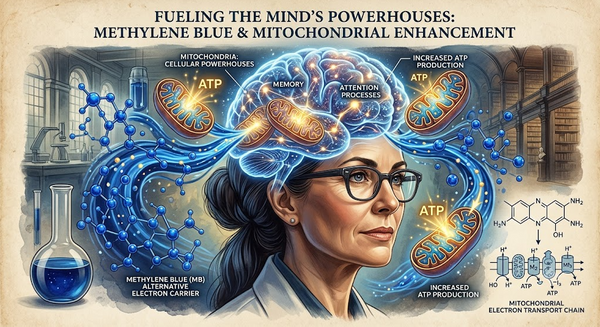
Methylene blue is a synthetic compound that primarily functions as a redox agent and alternative electron carrier. Its biological effects depend on both its concentration and the cellular environment. At the cellular level, methylene blue may support mitochondrial energy production by facilitating electron transfer within the electron transport chain, potentially improving the efficiency of oxidative phosphorylation while reducing oxidative stress.
Originally developed for clinical applications such as the treatment of methemoglobinemia and as a surgical staining agent, methylene blue has more recently become the subject of research investigating its effects on mitochondrial function, cognitive health, and healthy aging. While methylene blue is not approved as a dietary supplement or treatment for age-related conditions, emerging evidence has highlighted its potential role in supporting cellular function and health.¹
Why use Methylene Blue?
Significant interest in methylene blue arises from its association with mitochondria, which are frequently referred to as the "powerhouses" of the cell. Mitochondria generate the energy required for proper cellular function. Given the central role of energy production in maintaining health, researchers have investigated whether enhancing mitochondrial function may benefit tissues with substantial energy requirements. The brain exemplifies such tissue, as it depends on a continuous energy supply to sustain memory, attention, and other cognitive processes. Minor fluctuations in energy availability can influence neuronal function.
Pro-Tip: Quality & Pharmaceutical-Grade Purity Matters
When researching methylene blue for cellular health and anti-aging, sourcing and dosage precision are critical factors. Commercial and industrial-grade dyes often contain toxic chemical impurities and heavy metals like lead and arsenic, making them unsafe for human consumption. Only USP (United States Pharmacopeia) pharmaceutical-grade methylene blue provides the rigorous purity required for clinical applications.
Additionally, methylene blue exhibits a hormetic dose-response curve: precise low doses support mitochondrial electron transport and ATP synthesis, whereas excessively high doses can induce opposing pro-oxidant effects. Partnering with an established wellness compounding pharmacy ensures access to exact dosage customization, verified USP purity, and professional clinical oversight.
Potential benefits for patients:
Cognitive and Brain Health Support:
The brain has one of the highest energy demands in the body, consuming approximately 20% of the body's resting metabolic rate. Because of these substantial energy requirements, efficient mitochondrial function is particularly important for cognitive performance and overall brain health.
One of the most promising areas of methylene blue research involves its effects on brain function. In a randomized controlled study, low-dose methylene blue increased functional connectivity between brain regions involved in perception, memory, and cognitive processing. Researchers also observed changes in task-related neural activity, suggesting that methylene blue may influence how different regions of the brain communicate.²
These findings have generated interest in methylene blue as a potential neuroprotective agent and support continued research into its effects on cognitive performance and neurological health
Cellular Energy Production:
Research supports methylene blue's role as an alternative electron carrier within the mitochondrial respiratory chain, particularly when normal electron transport is impaired. According to Gureev et al. (2022), methylene blue can bypass dysfunctional components of the electron transport chain, helping to maintain oxidative phosphorylation and cellular ATP production.²
The same review also reported that methylene blue influences multiple pathways involved in mitochondrial health, including mitochondrial biogenesis, autophagy, and protection against oxidative stress and apoptosis. Because mitochondrial dysfunction is associated with aging, neurodegenerative disorders, and other chronic conditions, these mechanisms have generated significant interest in methylene blue as a potential tool for supporting cellular energy metabolism and mitochondrial stability.
Healthy Aging
Aging is often associated with increased oxidative stress, mitochondrial dysfunction, and the gradual accumulation of cellular damage. One of the key theories of aging centers on the role of oxidative stress. As cells age, the production of reactive oxygen species (ROS) can exceed the body's natural antioxidant defenses, leading to damage to proteins, lipids, and DNA. This process is believed to contribute to many of the physiological changes associated with aging and age-related decline.³
Methylene blue has attracted attention as a potential anti-aging compound because of its ability to act as a mitochondrial-targeting antioxidant. Research suggests that it may help support mitochondrial efficiency, reduce oxidative stress, and improve cellular energy production. By helping maintain healthier cellular function, methylene blue may support mechanisms associated with longevity and resilience during aging.
Although methylene blue has a long history of clinical use, many of its potential applications in cognitive health, neuroprotection, and healthy aging remain under investigation. Current research suggests that methylene blue may support mitochondrial function and cellular energy metabolism, but larger clinical studies are needed to better define its long-term safety and efficacy. As interest in functional medicine continues to grow, methylene blue remains a fascinating area of research at the intersection of neuroscience, cellular metabolism, and healthy aging.
Connect with Our Team in Fountain Hills
Citations
- Rodriguez P, Singh AP, Malloy KE, Zhou W, Barrett DW, Franklin CG, Altmeyer WB, Gutierrez JE, Li J, Heyl BL, Lancaster JL, Gonzalez-Lima F, Duong TQ. Methylene blue modulates functional connectivity in the human brain. Brain Imaging Behav. 2017 Jun;11(3):640-648. doi: 10.1007/s11682-016-9541-6. PMID: 26961091; PMCID: PMC5018244.
Gureev AP, Sadovnikova IS, Popov VN. Molecular Mechanisms of the Neuroprotective Effect of Methylene Blue. Biochemistry (Mosc). 2022 Sep;87(9):940-956. doi: 10.1134/S0006297922090073. PMID: 36180986.
Xue H, Thaivalappil A, Cao K. The Potentials of Methylene Blue as an Anti-Aging Drug. Cells. 2021 Dec 1;10(12):3379. doi: 10.3390/cells10123379. PMID: 34943887; PMCID: PMC8699482.